Showing posts with label Star Gazin'. Show all posts

Wednesday, June 20, 2012

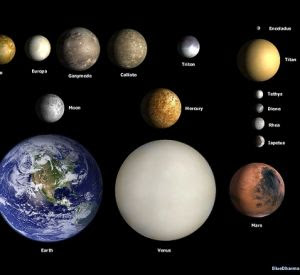
Side-by-Side Comparison of Humanity’s Notable Spaceships


Molecular astrophysicist "Invader Xan" has created an infographic, "Model spaceships", comparing the sizes of various space-faring vessels at Supernova Condensate.

Why? I'm not sure where you got lost when I said, "spaceships".

And you know what? S/he/It's blog has great stargazing tidbits like, "How to diffract a Cadbury’s creme egg…?" and including killer images of the Venus-Sun transit. You are not aware of my penchant with Venus-Sun porn? Then you are not following my Twiterfeed. Xan has also included bonus material (above) comparing fictional and non-fictional craft. [via Discover Magazine]

Wednesday, March 21, 2012

Neil deGrasse Tyson gets mad.


Neil deGrasse Tyson is an astrophysicist, current Director of the Hayden Planetarium and all around good guy. He is a frequent guest on The Daily Show and The Colbert Report and it's always a fun show when he's on. What I'm saying is we like him here at Candy Buffet. So when the seemingly nicest astrophysicist you'll ever meet starts ranting we tend to listen. And what is it that has him all riled up? The fact that we've all but abandoned manned (I want women astronauts too, sexy nerdy women astronauts) space exploration.

Back in 2010 President Obama cancelled the Constellation program and while he did increase NASA's budget he endorsed a kind of wishy-washy plan for the ultimate goals of NASA. He said, essentially, yeah, we should go back to the Moon and probably Mars and there are some asteroids and things we should check out but our current plans won't get us there so let's kind of, you know, do some studies or something. And probably the biggest shift was the decision to move away from government backed heavy lifters to a private enterprise based  system.

I don't like this and Mr. Tyson doesn't like this. As he points out, the space program of the mid to late 60's was a huge boon to the economy and the technological superiority of the U.S. as well as a great motivator to the next generation. Going into space in a sustained, permanent way should be the ultimate goal of humanity and we're not going to get there by saying maybe we should go check out some asteroids sometime.

Which is why I was pretty excited when Republican presidential candidate Newt Gingrich said that by the end of his second term we would have a permanent Moon base. Then my head exploded and I wept for 24 hours straight questioning my own existence, because, FU@#$%, I actually agreed with and liked something   horrible, hypocrite pus-bag Newt Gingrich said. But then it got worse, everyone started laughing at Newtie and I was in the position of defending him until I realized that Newt is probably basing his ideas on comic books and he's a crazy person that everyone laughs at all the time regardless of what he says.

Now I'm hoping someone in the Obama administration is listening to Mr. Tyson and not the people laughing at Newt because I do feel that a definitive statement from the President of a bold and clear plan outlining the next step in our exploratory journey could again reap vast benefits for all humankind. A statement like this one.

Friday, March 16, 2012

Some Planets Are Alien Invaders


In "Some Planets Are Alien Invaders", Science magazine explores the possibility of the existance of a super-large gas giant in our own solar system, far beyond Pluto.

The impetus for this theory is the number of exoplanets we have been discovering revolving around neighboring stars, more than 100 sun-Earth distances (AUs) from their stars. The Nature article, "So many lonely planets with no star to guide them", supports that the number of free floating planets in the galaxy may be more abundant than stars.

Ready for the big stuff? This theory isn't new. Nemesis theory has been bandied about since the eighties, suggesting that a (far away) brown or red dwarf may be orbiting the sun to explain for the elliptican nature of our planets' orbits and the large number of comets we see originitating from the oort cloud.

In the immortal words of Obi Wan Kenobi, "That's no moon".

Tuesday, February 28, 2012

Jupiter, Venus and the Moon dance in night sky


The light show's not over yet. Venus and Jupiter are due to pull closer and closer together until about March 12, according to the Washington Post's "Jupiter, Venus and the Moon dance in night sky; five planets come into view," (which includes a cool NASA video!).

If you can catch the action less than hour after sunset over the next few weeks, you can see Mercury too. Mars will be low and tight on the other side of the sky. Earth and Sky has a good field guide in "See all five visible planets in the February evening sky".

Want time and positions at your fingertips? Have smartphone will travel? I recommend Planets by Dana Peters. Then get high (in altitude people, but I'm not terribly picky) so you can get a view of the horizon and get busy.

Friday, February 10, 2012

ESA's Mars Express radar gives strong evidence for former Mars ocean


Appears Doctor Who was right. Again.

ESA news article, "Mars Express radar gives strong evidence for former Mars ocean," provides some pretty good food for thought about the past existence of water on Mars and even an ocean. Two oceans have been proposed:
"4 billion years ago, when warmer conditions prevailed, and also 3 billion years ago when subsurface ice melted."
The scientists are careful to detail that they don't think this second ocean existed for long enough for life to have developed, but its nice that they are not ruling out the possibility that further data collected on the first ocean might yield different results.

That being said, John Carter anyone?

Thursday, January 12, 2012

King of the Cosmos


Carl Zimmer's profile of Neil deGrasse Tyson, "King of the Cosmos," appears in the new issue of Playboy. I know, I know. But the profile is almost as awesome as Neil deGrasse Tyson (I love you!), himself. Thankfully, Zimmer has posted the proflie in its entirety at CarlZimmer.com. You should also check out Zimmer's blog, the Loom, at Discover magazine and his book, "Science Ink: Tattoos of the Science Obsessed," but that's another post.

Meanwhile, is it any surprise that Neil deGrasse Tyson is quickly eclipsing Uhura and Geordi La Forge on my secret list of science role models? He's even a real person!

 Also, I'm really terrible at keeping secrets.

Tuesday, November 9, 2010

We are all made of stars


It's Carl Sagan Day! Happy birthday Carl!

The Kepler spacecraft site is featuring winning entries from their Sagan Day essay contest.

Sponsored by Kepler and the SETI Institute, the contest honors, and was inspired by, Sagan's work and legacy.

At the site you'll find original music composed for the day, a remembrance by son Dorion Sagan, and the winning entry by Professor Renee James who shared this personal observation:

Carl Sagan was not an inspiration because he left everyone behind as he explored the farthest reaches of this universe. He was an inspiration because he invited us to accompany him on his journey, so that we could all get a small glimpse of that great cosmic ocean. And he convinced me that being a cosmic tour guide is as important as exploring a distant corner of the universe.


Image from Brian Clevinger and Scott Wegener's  Atomic Robo & The Shadow From Beyond Time #4 

Wednesday, October 20, 2010

Real Pictures of Alien Worlds


Imaging exoplanets (the term for planets outside our solar system) have come a long way since I brought an article discussing the first evidence of their existence into my "Current Problems in Astronomy" course in 1997. Phil Plait's, Bad Astronomy blog updates our ability to capture these elusive giants in his "Gallery of Exoplanets: Real Pictures of Alien Worlds." Don't expect details of planet surfaces and orbiting moons, for now we'll leave that to the matte painters of Star Trek, but do be prepared for spectacular spectrometry, Hubble images of multiple exoplanet solar systems and evidence of cold, cold worlds, some over 50 billion kilometers from their stars.

Thursday, March 25, 2010

Take me out to the black


200 miles up, and armed with an 800mm lens, astronaut Soichi Noguchi is able to capture amazing, abstract views of the Earth from his vantage point on the International Space Station. The station only got web access this year, but Noguchi is taking full advantage, posting his pictures to Twitter several times a day. Think about that the next time you're updating your foursquare location.

Follow him @Astro_Soichi. photo: Arabian sand dunes

Monday, March 8, 2010

Literacy, Curiosity, Education, And Being 'In Your Face'


Called, "the Carl Sagan of the 21 Century" and "sexiest astrophysicist alive" by Time Magazine, the director of the Hayden Planetarium at the American Museum of Natural History in New York, Neil Degrasse Tyson is not only the sometime guest of John Stewart's The Daily Show and Stephen Cobert's The Colbert Report. He's best known a that gutsy guy who took Pluto of the planetary guest list in 2006.

In NPR Interview "Neil deGrasse Tyson On Literacy, Curiosity, Education, And Being 'In Your Face'" he discusses the meaning of "science literacy", the importance of thinking for yourself, and why kids should be allowed to break things.

In high school, teachers warned me about spreading my interests too thin. The phrase "Jack of All Trades But Master of None," escaped one of their lips. So don't forget to read Linda Holmes epilogue, "Why Educators Need A 'Cultural Utility Belt," where deGrasse Tyson explains why that's just bunk. Hey, if it was good enough for Da Vinci then it should be good enough for grade schoolers.

You can catch deGrasse Tyson hosting Nova's Origins series and The Pluto Files on PBS.

Monday, November 16, 2009

Forest Park GIven Dark Sky Honor


The International Dark-Sky Association (IDA) holds the mission of preserving and protecting the nighttime environment and our heritage of dark skies. Their awesomeness is another post.

Today, the IDA has given Galloway Forest Park in Scotland their first "Dark Sky Award" outside the United States, declaring it one of the best places for stargazing in the world. A "Dark-Sky" Park is one where the darkness level reaches it’s lowest point on land, (defined as Bortle 2 on the Bortle scale John E. Bortle created and published in the February 2001 edition of Sky & Telescope. Darkness levels of Bortle 1 are only recorded on the ocean). A sky above Galloway Park can be seen in the above photograph: around 7000 stars are visible from Galloway Forest Park compared to the few hundred one sees from most cities enveloped in light pollution .

You can read more about Galloway Forest's Pitch Black sky and the selection process for the "Dark Sky Award" at the BBC's article, "Forest Park Given Dark Sky Honor," and Guardian article, "Scotland prepares to host Europe's first 'dark sky park'."

The Dark Sky Award selection process involves giving a rating via a sky quality meter, which measures the darkness of the sky overhead. Other Dark Sky Awarded parks are Natural Bridges National Monument, Utah; Cherry Springs State Park, Pennsylvania; Geauga Park, Ohio; and now Galloway Forest Park, Dumfries and Galloway, Scotland.

I want to go to there.

Friday, September 11, 2009

No Strain for Andromeda: Galaxy is Cosmic Cannibal


Our nearest, biggest and baddest neighbor, the Andromeda Galaxy has a dirty secret. It's a big eater. Long considered a suspect as a space predator, early results of the
the Pan-Andromeda Archaeological Survey (PAndAS) have found remnants of stars and smaller galaxies scattered around it like pizza bones after a college kegger. USA Today carries a layman's digest in their article, "No strain for Andromeda: Galaxy is cosmic cannibal," from the original Nature journal article.

Why should you care? Well, not only does cannibalism strip stars, over time re-arranging the night sky, but technically, Andromeda is moving toward us at a rate of 75 miles per second. That's an expected collision in about 2.5 billion years. While you may not need to start packing your bags, like the puppeteers of Larry Niven, plans for a galactic move take a millennia of planning.

Thursday, July 16, 2009

Giant Steps Are What You Take


40 years ago, with computing technology that could barely run a gameboy today, Neil Armstrong, Michael Collins, and Buzz Aldrin strapped themselves into a tin can and turned their eyes to heaven.

We Choose the Moon is a very cool interactive site that recreates the launch and mission through digital graphics, stills, and archival audio from mission control.

NPR has the story of the search for the original footage of the moonwalk - footage which NASA most likely TAPED OVER sometime in the 80's. As a librarian, I'm dying a little inside. But all was not lost, as you can see from the restored clips here.

UPDATE!  The National Geographic Society's library has compiled an exhaustive list of Apollo 11 links, articles, and blogs.  It's one stop shopping for all your lunar needs.  You know we bring you nothing but the finest time wasters.

Wednesday, May 27, 2009

Bad Astronomy


Phil Plait's "Bad Astronomy" Page is dedicated to pointing out popular misconceptions about our night sky why satisfying the common man's curiosity in the general workings of our universe. Check out the blog (hosted by Discover magazine) for current events gems, visit the "Misconceptions" page (bad idioms!) for nitpickin' goodness or hang out in the "Movies" section (um, try not to focus on the science in the new Star Trek movie) for hours of reading fun.

Tuesday, April 7, 2009

The high, untrespassed sanctity of space


Credit: NASA/CXC/SAO/P.Slane, et al.

NASA's Chandra X-ray Observatory recently snapped this shot of energetic particles streaming from a pulsar—the rapidly rotating core left behind after a very massive star exploded as a supernova.

Known as B1509, the pulsar is thought to be about 1,700 years old and lies roughly 17,000 light-years from Earth.

The tiny pulsar is just 12 miles (19.3 kilometers) wide. But it is spinning so fast—it makes a complete rotation about every seven seconds—that the particles it spews have created a nebula spanning 150 light-years.

Thursday, March 26, 2009

To the seat with the clearest view


Take a trip to a planetarium, and all eyes will be focused on the screen above, lost in a little slice of the universe brought to earth.  But what about the machines that create those images?

Their purpose is a bizarre reversal of a large optical telescope, taking an internal view of the universe and projecting it on a dome, rather than creating a view from peering outside of one, but the aesthetic is somewhat similar. Another curious similarity is how much they look like some early satellites.  


These beautiful works of art and engineering deserve consideration too. Oobject.com has a list of their picks of sixteen of the most interesting.  Commencing countdown, engines on.

Tuesday, March 3, 2009

This will revolutionize the Kessel run


Space, as we know from Douglas Adams, is big. Really big.  Samuel Arbesman's Milky Way Transit Authority distills the great vastness into a map that is elegant, accurate, and whimsical. Inspired by the classic London Tube map originally designed by Harry Beck, this work:

... is an attempt to approach our galaxy with a bit more familiarity than usual and get people thinking about long-term possibilities in outer space. Hopefully it can provide as a useful shorthand for our place in the Milky Way, the 'important' sights, and make inconceivable distances a bit less daunting. And while convenient interstellar travel is nothing more than a murky dream, and might always be that way, there is power in creating tools for beginning to wrap our minds around the interconnections of our galactic neighborhood.

His MWTA website also has links to other, earthly maps, including my personal favorite, the World Metro Map.

via

Wednesday, December 24, 2008

Ten Most Important Satellites Orbiting Earth Now


Remember that model solar system you made in the sixth grade? Well, now there is something more relevant and even closer home you can force your kids to make out of Styrofoam balls. It's a diagram of the "Ten Most Important Satellites Orbiting Earth Now," brought to you by IO9. Satellites are involved in every day of our lives from weather reporting to Google Maps to shooting television stations around the globe. So you might as well get on a first name basis with them. Well, all of them except Goldeneye that is.

Monday, December 22, 2008

Homeboy Astronomy


Marko Pyhajarvi writes the "Homeboy Astronomy" blog to help beginners and fellow amateur astronomers learn astronomy to start observing the stars and other interesting objects.

Marko is from Finland and he gives this little etymology about his blog's title " 'Homeboy' can be understood as “a hometown boy, a close friend”. A close person of mine called me homeboy some time ago." Oh, cute! I'm not sure he realizes just how sweet and welcoming his slang usage is in the states.

In any event, Homeboy Astronomy gives accessible, practical advice about backyard astronomy sprinkled with astronomical factoids and tidbits. Now, he can be your homie too.

Friday, December 12, 2008

Year's Biggest Full Moon Friday Night


As you go out in search of the first stirrings of Holiday parties, remember to look up as the sun is setting. According to the LiveScience article, "Year's Biggest Full Moon Friday Night" earth's natural satellite reaches its closest point to our planet, tonight meaning it will be 4 percent bigger in our sky and 30 percent brighter than some other full moons during the year. Oh, and expect record tides, too.